

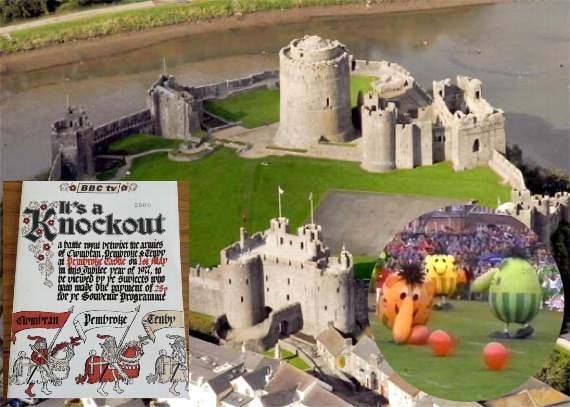
Back in 1977 teams from Tenby and Pembroke competed against Cwmbran as part of the popular prime time BBC programme ‘It’s a Knockout’ - a British game show which featured teams representing a town or city, competing against each other in absurd games, generally dressed in large foam rubber suits!
The show first broadcast in 1966, which ran for 16 years on the BBC was adapted from the French show Intervilles, and was part of the international Jeux sans frontières franchise.
The much-loved show - once described as ‘the zany Olympics’ - would see domestic heat winners would go onto face their European counterparts in historic and exotic locations on the continent.
1.jpeg?width=209&height=140&crop=209:145,smart&quality=75)
At the height of its popularity the show was a huge ratings winner, and even featured members of the Royal family captaining celebrity teams for charity specials of the show in the 1980s.
The show featuring Tenby and Pembroke was filmed on Sunday, May 1, with the games played within the grounds of Pembroke Castle, and the programme broadcast on BBC One on Friday, May 13 that year - in the prime time 8 to 9 pm slot.
The Tenby team sported some very notable competitors in its ranks - Welsh Rugby Union international Barry Llewelyn, who played for Llanelli and was capped for his county on 13 occasions; and Rebecca Naden who went onto become an award winning sports photographer primarily for the Press Association and global agency Reuters.
Team captain James ‘Jim’ Muir was coach at Tenby Swimming Pool and, as well as holding just about every swimming award and certificate there was. He was also the first person in the United Kingdom to complete the one million yards swimming badge!
The full Tenby team was as follows: James D. Muir (Captain), Penny Hilling (Ladies’ Team Captain), Gaynor Blackmore, Jeremy Bowen-Rees, Stuart Brace, Alan Brindley, Jayne Brindley, Penny Close, Richard Evans, Roland Grigg, Neil Hammersley, Richard James, Barry Llewelyn, Sarah McLaughlin, Rebecca Naden, Cyril Walters, David Williams.
The Pembroke team included - Sandy Buttle (Team Captain), Thea Bigland (Ladies’ Team Captain), Dai Boswell, David Boswell, Terry Davie, John Hammond, Marina Harwood, Graeme Jones, Mike Jones, Mike Lampard, Aileen Miller, Huw Morgan, Petrina Pearson, John Phillips, Trevayne Pudsey, Janet Tallett, Helen Thomas, Andrew Walters.
According to the website JSFnetGB (an online guide to the classic television series) the games ran as follows:
The first game - ‘Bag Race’ - saw one man and one girl from each team run from the start line to place each of their feet into a bag and, holding the straps, they hop down the course to stand on a podium. Six people race for five podiums, so one person is eliminated; he or she also eliminates his or her team partner. The game is repeated with four people racing for three podiums to find the winning team.
The second game - ‘Get to Grips’ - featured two men and two girls wearing clown trousers and flippers who have to run from the start line to climb on to a dome. The team to climb on the dome in the quickest time - and stay on the dome - wins.
The third game - ‘Best Foot Forward’ - was played by two men and a girl who are required to go through obstacles wearing massive false feet and carrying buckets of water.
Pembroke’s Graeme Jones, Andrew Walters and Aileen Miller finished this game in joint second place, tied with Tenby’s Cyril Walters and husband and wife team of Jayne and Alan Brindley.
Game 4 - ‘Ski-Race’ - featured two men standing on skis. At the whistle, one girl had to run from the start line to stand on the skis between the two men, who can then start to walk along the course to collect another man - he stands between them. All four then return for the last man, who stands between the two men operating the skis. The team of five then return to the finish line, with the first team to finish winning.
Pembroke won this game and scored double points, as they had presented their joker.
The fifth game - ’Bounce Around’ - was played two men who had to push a cart up and down a course. On top of the cart, lying on a sponge slab, was a female team member. At the far end of the course she had to collect an additional sponge slab and place it on the cart, before climbing back on top of the thickening sponge, and returning to collect another at the opposite end. The team collecting the greatest number of slabs within limit time would win, which Tenby did!
The sixth game - ‘Nosey’ - saw two men and one girl wearing fat costumes with large noses on their heads, which they use to pass quoits to one another. At the start a girl had to throw a quoit onto the first man’s nose. He was then required to run to pass it to the next girl, who then had to run to pass it to the second man. In turn, he then had to run to pass the quoit to the first man who has taken up a position on the empty disc. Each competitor had to move up in turn and so on until the last person dropped the quoit in the box for scoring. The team collecting the greatest number of quoits in limit time wins.
Game 7 - ‘Long John Knockout’ - was played by one man with his leg strapped up, who had to hop down the course on obstacles, collecting various items to deposit in a score box at the end of the course. David Williams won this game for Tenby.
The eighth game - ’Board Walk’ - witnessed two men and two girls lined up in a square by their ankles. A girl had to fill a bucket with water and then place it on a panel balancing on their heads. They then had to carry the bucket up the course and empty it into the water scoring container. This task completed, they had to return to collect more water. The team with the most water in the container wins.
The Marathon game - ‘Pin Head’ - took place between the other games in this heat, with teams playing individually. It involved a male team member, wearing a spiked helmet, riding round a circular course on a tricycle. Each time he completed a circle, he would score one point. A girl from the opposing team was in the middle of the circle on a podium and she had to catch a water-filled balloon, which was thrown to her by another girl, outside the circle. The girl in the circle had to throw her balloon to burst on the spiked helmet of the man circling the course. If successful, the man would lose a point for that round. The winner would be the team that had amassed the most points for clean circles after any penalty deductions.
Game 9 - ’Giant Race’ - was played by one man from each team, each of them racing from a start line to finish line wearing a giant costume. They had to race over obstacles on the course with the giant who crossed the finishing line first being declared the winner.
Recently retired Tenby firefighter Richard ‘Jammy’ James who was in the team said that he remembers the day well, and confirmed that Barry Llewellyn was the designated ‘joker’ for his side, set with the task of winning double points when played.
Tenby AFC’s Dene Hurlow (whose wife Penny - nee Martin was one of the Tenby team cheerleaders for the day - and kindly contributed the photographs for this article) said: “Barry was the only person ever to fall over in one of those costumes and get up again unaided - terrific strength!”
At the end of the competition, Cwmbran led the way with 26 points, with Pembroke finishing on 25 and Tenby on 24. Winners Cwmbran qualified for Jeux Sans Frontières to be staged at Ludwigsburg in Germany in July of that year.
Comments
This article has no comments yet. Be the first to leave a comment.