

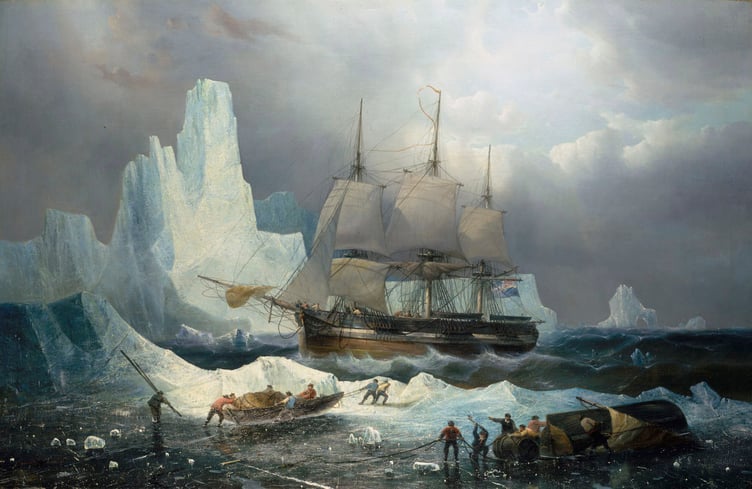
HMS Erebus was a three-masted ship 105ft long, 28.5ft wide with a draught of 13.8ft and a displacement of 372 long tons. Originally a Royal Navy bomb vessel, she was built and launched in Pembroke Dock’s Royal Dockyard on June 7, 1826.
In Heritage Centre patron John Evans’ words, Erebus “embodied the exceptional skill of Pembrokeshire’s 19th-century shipwrights and went on to prove the far-reaching impact of Welsh maritime craftsmanship.”
In her early years at sea, the power of this small ship singled her out as perfect for polar exploration. The use of bomb vessels in polar exploration was common during this time, their strong internal framework and robust construction meaning they were much more likely to survive pack ice and icebergs.
After shipwrights had added reinforcements inside and out, Erebus went on to play a pivotal role in some of the most important explorations of the age including James Clark Ross’s pioneering Antarctic Expedition (1839-43). The Royal Navy had installed adapted railway locomotive engines for steam power “only in circumstances of difficulty”.


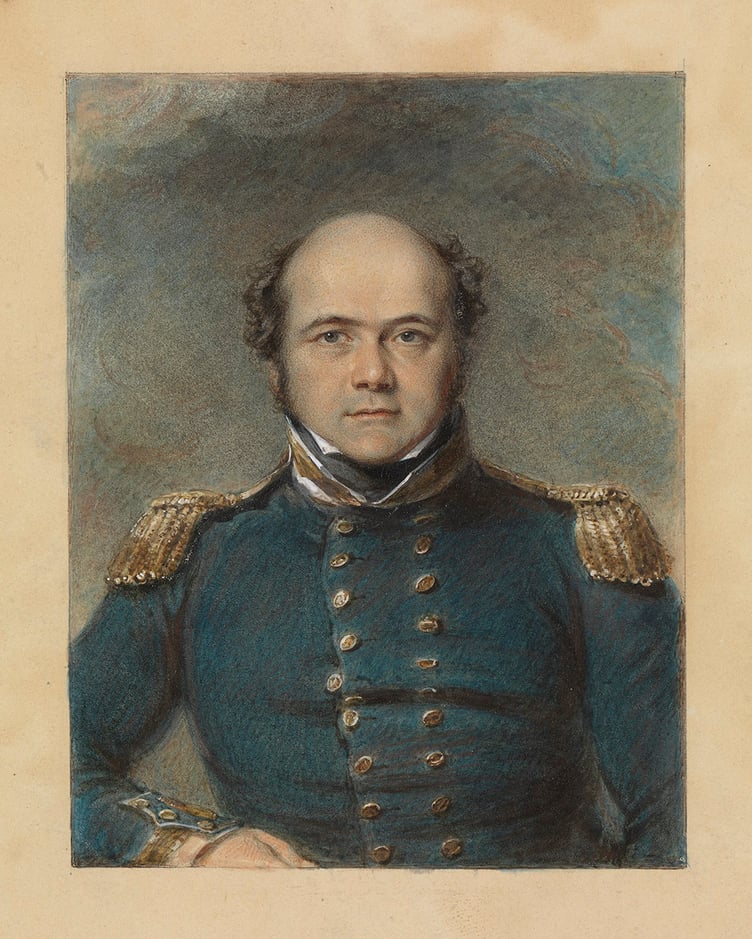
The stern of HMS Erebus was modified to accommodate a propeller for its next expedition, adding about three feet to its length, but it was this expedition - to the Arctic, with Captain Sir John Franklin on board and Commander James Fitzjames as captain - that saw the tragic loss of ship and crew.
The true story of the ill-fated Franklin Expedition, on which HMS Erebus and her expedition partner, the similarly equipped HMS Terror, set off to the Arctic in 1845 in search of the Northwest passage and never returned, is shocking. All 129 crew members were lost, and initial searches proved unfruitful.
In 1854 the fate of the expedition was largely revealed by Scottish explorer Dr John Rae from interviews with Inuit hunters. Rae brought back relics and tales that the ships became icebound, and the remaining crew died of starvation and exposure while attempting to walk to the Canadian mainland. In a confidential report to the British Admiralty detailing the tragic findings, Rae retold the story as it was told to him: “From the mutilated state of many of the corpses and the contents of the kettles, it is evident that our wretched countrymen had been driven to the last resource - cannibalism - as a means of prolonging existence.”
Writing for Royal Museums Greenwich, Sophie Warburton reveals: “Rae also wrote a second sanitised report, intended for the public, which omitted the charges of cannibalism. The Admiralty released the wrong report to the press, causing a nationwide outcry, with the public believing, along with Lady Franklin, that such action was incompatible with the behaviour of Royal Navy sailors.
“[Charles] Dickens, who had already published several articles, poems, and short stories regarding the fated expedition, was strongly of the same opinion as Lady Franklin. With her support, he publicly discredited Rae’s evidence in articles published in the journal Household Words.”
Both Franklin expedition ships, travelling close together through the narrow channels of the Northwest Passage, encountered a heavy advancing ice sheet simultaneously off the coast of King William Island (also known as Qikiqtaq). A handwritten record, recovered by a search expedition in 1859, states that both ships were “beset” together in the ice pack on September 12, 1846. The crews endured two punishing winters before finally abandoning the vessels.
But how did the crew members survive for nearly two years in such conditions? They had come prepared. The Parks Canada website gives us some clues:
“The 1845 expedition led by Sir John Franklin was well prepared and expertly equipped, by European standards. He set sail in ships outfitted with the latest technologies. The ships carried three years of supplies although Franklin believed they could be stretched to five years with careful planning.”
And: “The ships had special cooking stoves with tanks above them for melting ice and snow to create fresh water. The ships also each carried a patented heating apparatus to distribute warm to both the officer’s cabins and crew’s living quarters.”
In addition to their Naval or Royal Marines uniforms, crew members were issued with warm clothing. Harry D S Goodsir, assistant surgeon aboard HMS Erebus, made his own list which included such items as deer-skin trousers, lambskin waistcoat, sealskin greatcoat, three pairs of sealskin gloves, chamois skin shirts, grampian stockings and three pairs of strong boots.
“The seasoned sailors in Franklin’s crew knew Arctic winters were long. Keeping up morale during the cold, dark, 24-hour winter darkness was essential for physical, spiritual, and mental survival. Entertainments, research projects, and moral guidance helped.
“Supplies such as slates, pens and ink, paper and instruction books were provided to help teach crew members during the long winter months. The combined libraries of both ships contained around 3,000 books and magazines.” Ibid.
Artefacts recovered from the wreck of HMS Erebus help to paint a picture of life on board. They include, a ship’s bell, a sextant, a wool-lined patent leather boot and an oilskin (textile raincoat made water-resistant with the application of melted grease and tar), a razor and shaving brush, a medicinal vial, pestle and pharmaceutical bottle, a pistol, a reel for a fishing rod, an eyeglass lens, a watercolour palette, an ink bottle, a pencil case, a barrel organ, an accordion, a mustard pot, ’blue willow dinner plate’, a china bowl, a wine glass, coffee beans and much more besides.
In fact, there are thousands of artefacts remaining on the two shipwrecks, which may well include written documents. In a pioneering collaboration, Inuit and Parks Canada experts are working together to unravel the mystery of the Franklin expedition still further with the help of these objects.
On April 22, 1848, after the Erebus and Terror had been frozen in Arctic ice for over 19 months, and 24 men, including Franklin, had died, 105 survivors attempted to save themselves by walking and dragging boats on sleds along the west coast of King William Island, Nunavut. Tragically, all 105 died trying to escape.
Their food supplies had included flour, chocolate, salt beef and over 8,000 tins of newly introduced preserved meats and vegetables. Sadly, this might have their undoing. Historians continue to debate the significance of Owen Beattie and John Geiger’s claim in the 1987 book ‘Frozen in Time’ that poorly soldered tin cans leaked toxic lead into the crew’s food supply. On one hand, that Inuit reported seeing expedition members behaving oddly would seem to confirm the theory. On the other, as Tamara Varney, of Lakehead University’s anthropology department pointed out, that’s “probably not surprising when you’ve been stranded for two or three years, and you don't have a lot to eat, and you’re really cold.”
The wreck of HMS Erebus, having drifted south amid the ice pack before eventually sinking, was lost for over 160 years until its discovery by underwater archeologists on September 2, 2014, thanks to the combined power of modern technology, traditional Inuit knowledge and the sheer determination of the researchers.
The ship appeared on the sonar screen, plain as day. Parks Canada senior archaeologists Ryan Harris and Jonathan Moore had been staring at this screen - or one like it - for years, looking for any sign of Franklin’s lost ships, but this day was different, as Government of Nunavut archaeologists had discovered on the shore of a small island a davit pintle (a mechanism for raising and lowering small boats) and a wooden deck hawse plug (a waterproofing device for a rope-hole) just the day before.
“You can’t imagine how incredible it felt when, not even halfway on the screen, the shipwreck emerged perfectly recognisable,” said Harris, who had adjusted his search area based on the new finds.
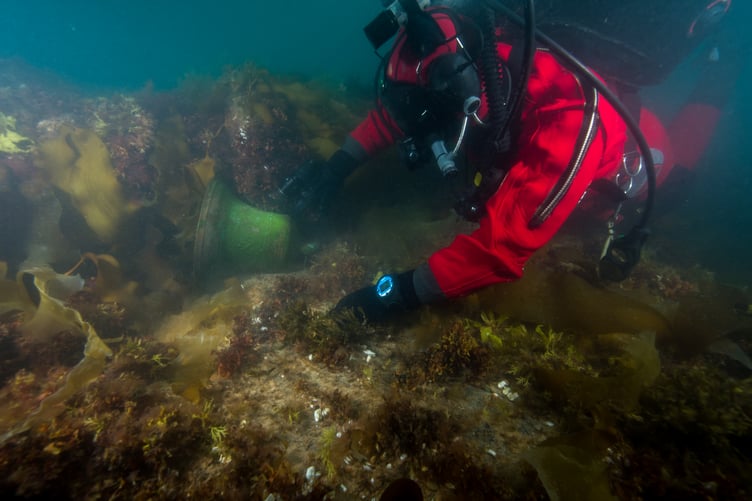
The discovery of Erebus’ wreck below the icy waters of the Canadian Arctic in 2014 reignited worldwide interest in the mystery and legacy of polar exploration.
In February of this year, Pembroke Dock Heritage Centre announced with delight that it had been awarded a £57,015 grant from The National Lottery Heritage Fund to develop a major new exhibition, ‘HMS Erebus: From Dockyard to Discovery’.
John Evans said: “Thanks to the National Lottery, this project will preserve and celebrate a heritage story of national and international significance, while re-establishing Pembroke Dock as a place of discovery, craftsmanship, and exploration.”
While the exhibition was being prepared, a new development in DNA analysis during May 2026 led to the identification of four further crew members from the Franklin Expedition, bringing the total to six.
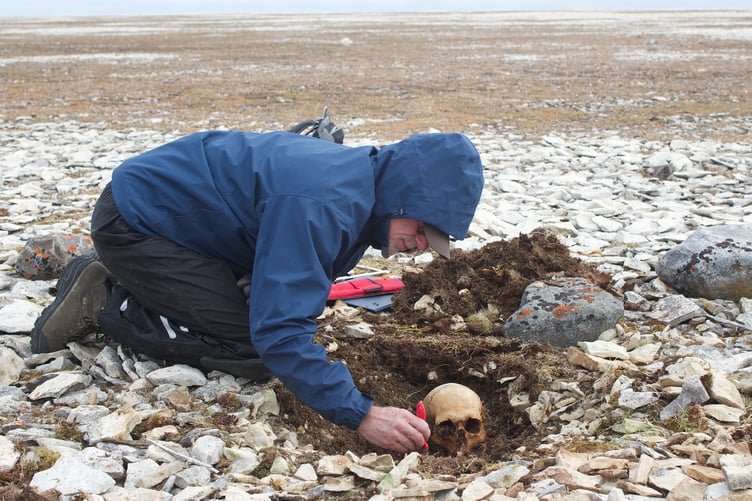
Scientists have only had 10-12 years to unpack the wealth of information from the two shipwrecks, but the remains of the Franklin expedition members have been found on the island and the Adelaide Peninsula ever since the mid-19th century.
To identify these sailors, and to provide critical insights into their escape attempt, University of Waterloo anthropologists led the work in matching DNA samples from the skeletal remains with samples donated by living descendants.
“Three of the sailors we have identified are from HMS Erebus, and they all died at Erebus Bay. The fourth, the only sailor from the HMS Terror to be definitively identified by DNA analysis, was found 130 kilometres away,” said Dr Douglas Stenton, Adjunct Assistant Professor of anthropology at Waterloo.
The lone sailor was identified as Harry Peglar. Confirming his identity ended a 166-year-old mystery as his body had been found carrying his seaman’s papers, poetry and apparent descriptions of some events from the expedition, but he was wearing a uniform that didn't match his rank.
Two of the Erebus crew members confirmed in these latest findings were Able Seaman William Orren and Boy 1st Class David Young. An Investigative Forensic Artist has even been able to provide a sketch of the Erebus cabin boy David.
BBC journalist and presenter Rich Preston discovered through this research that he is a descendant of the other crew member identified in this latest batch, Subordinate Officer’s Steward John Bridgens.
Preston said: “I was so intrigued when Dr Stenton first contacted me telling me about his work and asking if I’d be willing to provide a DNA sample. It was such a huge surprise to hear from the team that my DNA was a match with one of the sailors on the doomed Franklin expedition.
He added: “I used to work on a genealogy show for the BBC that traced people’s fascinating family stories, and so to discover that there’s such an interesting tale in my own family’s past feels very exciting.”
All three were among the crew who survived the first three years of the expedition and attempted to escape the Arctic.
The remains of these recently identified sailors show no evidence of cannibalism, in contrast to the body of James Fitzjames, the Captain of HMS Erebus, the identity of which was confirmed alongside Erebus Engineer John Gregory.
At Pembroke Dock, for the first time, rare artefacts recovered from the wreck will be displayed to the British public, offering tangible connections to life on board and the extraordinary challenges of 19th-century polar exploration. The exhibition will also place HMS Erebus within the wider heritage landscape that shaped her creation, exploring Pembroke Dock’s role in Britain’s maritime expansion, the Georgian dockyard where 263 Royal Navy vessels were built between 1816 and 1922, and the community that grew around it.
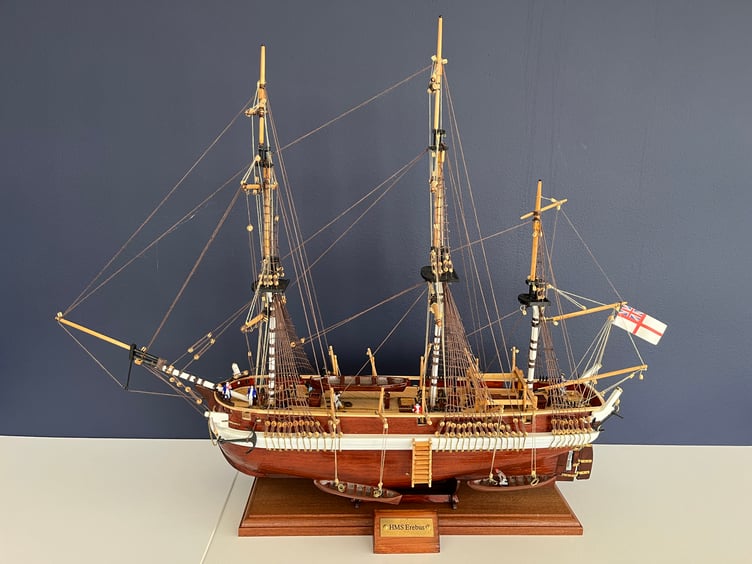
Through bilingual interpretation, digital interactives, and an immersive Arctic diorama with scale model, showing Erebus trapped in the ice, visitors will discover how a ship built in a small Welsh town contributed to major advances in global scientific knowledge.
Visitors will be invited to step inside a recreation of a ship’s cabin to view the artefacts, and admire a “holographic” image created from detailed and accurate 3D scans of the ship’s bell (produced by the Coastal and Inland Waters Heritage Science Facility, University of Southampton).
A digital interactive touchscreen display will let visitors explore route maps, the mysteries of the disappearance and the grim fate of the crew, as well as the clever adaptations that equipped the ship for polar exploration, and the role that local Inuit played in locating the wreck over a century later.
Undersea video footage from the wreck site and contemporary environmental perspectives will link historic exploration to modern discussions about climate change and the fragility of polar environments.
Drawing on oral histories and shared memory, community engagement sits at the heart of this bilingual exhibition. There will be quizzes and activities for children and school visits will be encouraged.
‘HMS Erebus: From Dockyard to Discovery’ will be open to the public from Monday, June 8, until the end of October 2026. The museum is open Monday to Friday, 10am-4pm.
Comments
This article has no comments yet. Be the first to leave a comment.