

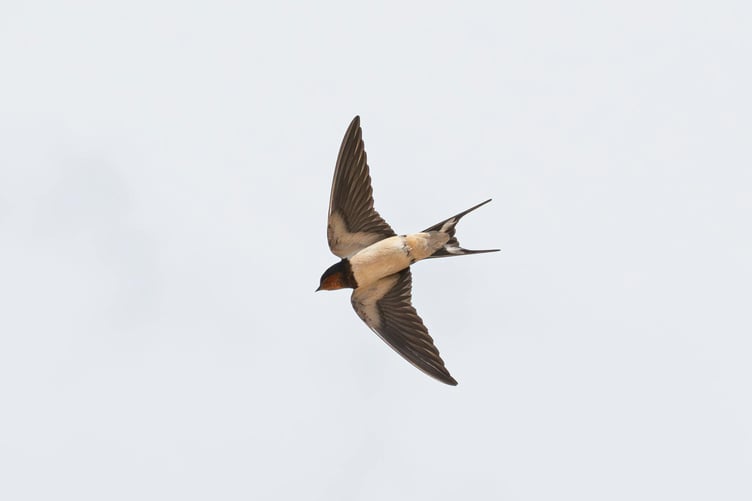
IT may have taken a little longer in Pembrokeshire this year, but an East Williamston resident now knows spring has sprung, following the sighting of four swallows!
The swallows - traditionally regarded as harbingers of warmer weather - were spotted by David Badham at Church Farm around 3pm on April 7.
The first confirmed sightings of swallows (Hirundo rustica) in the UK as a whole began a lot earlier with one recorded on February 19 on the Isles of Scilly.
Closer to home, 12 swallows were spotted at the WWT Llanelli Wetland Centre in Wales on March 9.



According to recent birding reports, swallows have been spotted in Pembrokeshire in late March and early April:
March 27, 2026: At least three swallows were seen in Nevern village.
March 29, 2026: A single swallow was spotted at Rickeston, near Milford Haven.
April 5, 2026: A “steady passage” of swallows was observed heading towards Fishguard along the coast south of the Fishguard Bay caravan park.
April 6, 2026: Two swallows were reported on electricity wires in an unspecified Pembrokeshire location, noted as being early for “breeding swallows.”
Swallows spend their winters in warmer climates, such as Africa, before journeying over 6,000 miles to return to Europe and other northern regions, typically in late March or early April.
Swallows are regarded as heralds of spring primarily because their migration patterns align with the change of seasons, marking the end of winter and the beginning of warmer weather. Their reliable return to the same nesting spots each year has made them cultural symbols of hope, renewal, and homecoming.
In Christian culture, swallows are sometimes associated with the Resurrection, as their return often coincides with Easter.
Swallows have glossy, dark blue-black head and back, and a distinct dark red forehead and throat. The underside is creamy-white or buff-coloured, often with a dark blue-black band across the chest.
The easiest way to identify a swallow, specifically the commonly seen Barn Swallow, is by its long, deeply forked tail with thin "streamers"
Comments
This article has no comments yet. Be the first to leave a comment.