

If you’re thinking of buying a house by the sea, river or any watercourse in Wales, be aware of the risk.
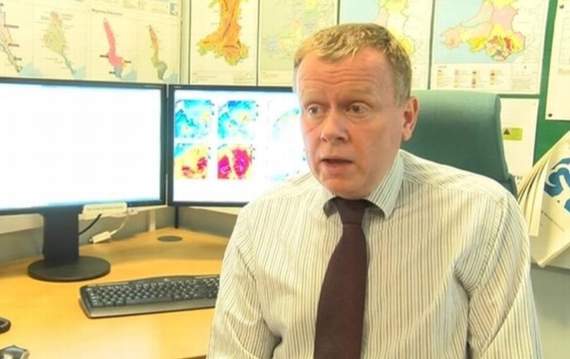
That’s the message from Natural Resources Wales (NRW) flood expert Jeremy Parr.
“I wouldn’t go as far to say don’t do it, but you need to be conscious of what the risks are,” he said.
Last winter’s storms peaked in February, culminating in Storm Dennis when thousands of properties flooded in Wales.




The statistics are sobering: 51 of Wales’s 231 river gauges recorded their highest ever levels during the storm. 158 flood alerts, warnings and severe warnings were issued.
As well as the physical and economic toll was the human one.
A study has found a significant link between being forced out of your property due to flooding and symptoms of depression, anxiety and post-traumatic stress.
Householders can be in-limbo for months or even years, and risk not being able to re-insure their property.
“Every time it rains they are worried about it – particularly elderly people and children,” said Mr Parr, NRW’s head of flood and incident risk management.
“The mental health impact is huge.”
NRW has published the findings of a review of the February floods, which concluded that defences largely held firm – although some were over-topped – but that the environmental watchdog struggled as an organisation.
It failed to issue 12 flood warnings, and three were issued late.
NRW’s resources, said the review, “could not fully cope with the size of the task at hand for an event of this scale and significance”.
And it said there were no silver bullets.
It seems that building our way out of trouble won’t work, so tough calls have to be made.
There are considered to be 117,100 properties at high risk of flooding in Wales, 44,668 at medium risk and 83,350 at low risk.
The Welsh Government, which published an updated flood risk management strategy last month, wants a big conversation on the topic.
Its strategy said homes and businesses in 40 coastal areas may need to relocate by 2100.
Coastal flooding and erosion are addressed in four shoreline management plans covering Wales.
They throw up four options: maintain or improve existing defences, advance the existing defence line, allowing the shoreline to retreat in a managed way, or shelve defence investment and let nature take its course.
“Difficult decisions will need to be made as to where investment is directed and how we adapt,” said the Welsh Government’s strategy.
When asked if he considered flooding from rainfall to pose a greater risk in Wales than coastal flooding, Mr. Parr said: “Around 90,000 properties are at risk of fluvial (river) flooding, 71,000 from tidal (the sea), and 131,000 from surface water (drains, saturated ground), so you would say surface water water is the biggest risk, but it’s not necessarily the worst flooding.
“It tends to be low level – not so deep, not so fast, not so dangerous. Flooding from the sea and rivers is a lot worse.
“The future is a bit more speculative. There are projections of a 1.13m sea level rise by 2100 in some scenarios, but when you add storms, waves and surges it’s more than that.
“Wales has a lot of population and infrastructure on the coast. But it has a large population by rivers inland.”
NRW receives around £10 million to £20 million of capital money a year from the Welsh Government for new and existing defences.
It also receives around £6 million in revenue spending on flood defence maintenance – things like new seals, and cutting back weeds.
When asked what his advice is to anyone who is planning to buy a home by the sea, Mr. Parr commented: “Shoreline management plans are living documents and are going to be refreshed in the next 12 months.
“They indicate a direction of travel and don’t set time frames.
“But there’s no hiding from it - we can’t ignore the risk and it would be wrong to.
“I think it’s important that people are aware of shoreline management plans.
“My advice to people who are planning to buy a home by the sea is be aware.
“I wouldn’t go as far to say don’t do it, but you need to be conscious of what the risks are,” he added.
Comments
This article has no comments yet. Be the first to leave a comment.