
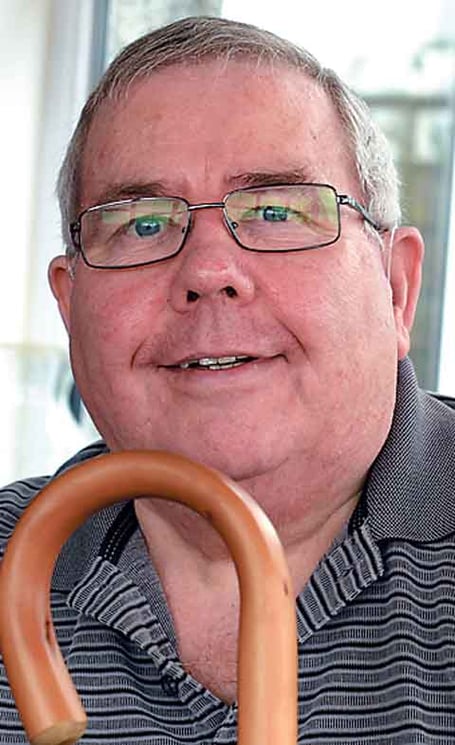
A stroke victim from Narberth is supporting this month's Lower Your Risk of Stroke campaign by Stroke Association Wales by sharing his story and urging people to lower their risk of suffering a stroke.
Albert's story
Albert Fraser, 65, from Narberth, had a stroke in May 2013 while he was working as a support worker with people with autism. He was home with his wife, Myfanwy, watching TV when he suddenly felt something was wrong.
Albert explained: "It was about 9 pm and Myfanwy had left the room to talk to a friend on the 'phone. My right side suddenly went numb and I thought I was shouting, but nothing came out."



When Myfanwy came back into the room she saw that one side of Albert's face had dropped and immediately called 999. Albert got to hospital quickly and received thrombolysis, a clot-busting drug that disperses clots and returns the blood supply to the brain. Albert was in hospital for eight weeks where he received physiotherapy to help him with his right-sided weakness.
Albert now walks with two sticks and has lost all feeling down his right side. He can't differentiate between hot or cold and he can't tell if someone touches his arm.
A few weeks before his stroke in May, he had a mini stroke. He didn't know what was happening, but he had a terrible headache and his speech became slurred. Albert was aware he had a family history of stroke, but as he was only 63 he didn't know he was in danger.
Albert said: "I'm keen to help raise awareness of TIA as I still experience them. I have had three altogether and each time I have a headache and my body sort of switches off. It is a horrible thing to experience, but I still count myself lucky and I'm always keen to take the clot-busting drug that the hospital recommended.
"Despite my post-stroke symptoms, I've realised that life goes on and you've got to get on with it. I want to watch my grandchildren grow up, so I'm keeping active as well as I can and trying not to be a couch potato. I want to make sure I don't end up like my father who had a serious stroke and completely lost the use of one arm."
Albert now attends a stroke support group in Haverfordwest who meet once a week and organise outings such as a Christmas dinner.
He added: "The volunteers are wonderful. They are so patient and supportive. It means a lot that I can socialise with other people who have experienced a stroke."
Lower Your Risk of Stroke campaign
A new campaign funded by the Welsh Government is raising awareness of the three biggest risk factors for stroke: high blood pressure, atrial fibrillation (AF) and Transient Ischaemic Attacks (TIA), also known as mini strokes or 'funny turns.'
The Lower Your Risk of Stroke campaign by Stroke Association Wales, Public Health Wales and Community Pharmacy Wales shows what the public can do to lower their risk.
Ana Palazon, director Cymru at the Stroke Association, said: "We are asking people to do three simple things. Get their blood pressure checked on an annual basis, check their pulse for any irregularity and, lastly, seek urgent medical attention should they experience stroke symptoms. By taking action on these three things, we could reduce the number of strokes across Wales by up to 50 per cent."
Uncontrolled high blood pressure accounts for up to 40 per cent of all strokes. AF is the most common heart disorder in Wales. Those with AF are five times more likely to have a stroke and AF strokes are more likely to lead to death or leave the stroke survivor with high levels of disability.
The third biggest risk factor is TIA which happens when the brain's blood supply is interrupted for a short time only. Symptoms are the same as stroke, but they are temporary. Often, people dismiss the symptoms of a TIA as a 'funny turn,' however, doing so could endanger life as TIA is a contributory factor for 21 per cent of all strokes.
The Stroke Association is working with Public Health Wales, Community Pharmacy Wales and the seven health board's across Wales to raise awareness across the whole population. The focus of the campaign will be asking members of the public to take responsibility for regularly checking their pulse and blood pressure and making sure they act when they suspect an irregularity or experience stroke symptoms.
Ana continued: "All stroke symptoms should be treated seriously, no matter how quickly they pass. People should look out for facial weakness or drooping, loss of mobility down one side or problems with speech.
"The Act FAST message is vitally important, as the sooner people get medical help, the better their outcomes and the lesser their disability. Don't ignore funny turns, get to hospital."
As part of the integrated campaign, all community pharmacies will be offering a quiz to those aged over 50 to reinforce the importance of a blood pressure and pulse checks and to remind them of the FAST message. Those who are on medication for either high blood pressure or AF will also be given stroke awareness advice and told how important it is to have a medicines usage review on a regular basis.
For more information about the campaign, please visit http://www.stroke.org.uk">www.stroke.org.uk or follow on twitter @strokewales. If stroke has affected you or a family, please ring the helpline on 0303 3033 100.
Comments
This article has no comments yet. Be the first to leave a comment.