

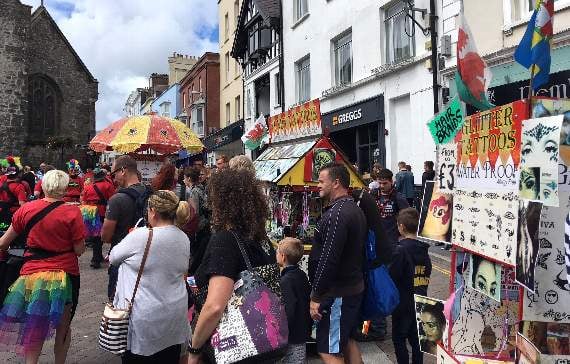
A comprehensive review of ‘street trading’ matters is set to go before Pembrokeshire County Council’s cabinet in November.
Last week, county councillor Michael Williams, who represents the Tenby North ward, hit out at the authority for their failure to tackle unauthorised ‘street trading’ in the historic town once again this summer, writing to PCC’s head of legal services, Claire Incledon, requesting an urgent update on the latest position.
Clr. Williams stated that the situation was now ‘considerably worse’ than previously, with footpaths and the highway being obstructed by street traders.
He said that it was his understanding that this form of trading would be stopped by this time with the implementation of new ‘bye laws’.



“The impression given of this historic town is frankly appalling,” said Clr. Williams.
“The entire impression does not reflect the quality tourism that visitors seek these days, and that most of those who pay very high business rates strive to offer, and it is the responsibility of the county council to address this decline in standards. Thus far it has totally failed!” he added.
Now PCC’s head of highways and construction, Darren Thomas, has provided Clr. Williams with an update on the matter, explaining that a report to the cabinet was issued in March, with a deadline of further reporting to cabinet in November highlighted.
“The idea of a bye-law is being reviewed, but this is not that straightforward,” he said.
“It is clear that combining the discussion on street trading with that of regulating henna tattooists and hair braiders is confusing.
“They are different aspects of law - people selling things like ice-creams, goods, etc - are trading, and can therefore be covered under a ‘Street Trading Consents Scheme’.
“The documentation and approach for this is being reviewed and updated - it is relatively straightforward.
“People like the henna tattooists, hair braiders, buskers, face painters, etc - are not traders - but a service provider. They cannot be regulated under street trading powers.
“The issues that need to be considered are things like: the public interest case; the potential for a resource heavy process; that bye-laws are a council function and appetite for this; is there really a significant problem? (complaints in relation to these services as being a problem?); even if a byelaw was introduced would this actually help, as who would enforce?; what councillors, town councillors and other stakeholders really want, e.g. a proactive (bye-law) approach, or a reactive (public space protection) approach.
“All these issues are what we are reviewing further,” continued Mr. Thomas.
In response to the correspondence, Clr. Williams said that on Friday he collated a photographic record of the traders / service providers currently operating.
“At 3 pm today there are six braiders, six different tattoo sellers stalls, and one trader selling soft toys in the town centre!
“The footpaths in St. Georges and Church Streets are completely blocked, and one entrance through the Five Arches is obstructed.
“One user of an invalid vehicle informed me that she was required to vacate the footpath and use the highway in St. Georges Street,” he remarked, explaining that he had also notified Dyfed Powys Police of the issues.
Clr. Williams also stated that he had concerns regarding the suitability or otherwise of some applying tattoos and braiding.
“Sometimes young children appear to be unaccompanied when availing themselves of these services. Are these ‘service providers’ DBS checked?” he commented.
“The authority has at least a moral, possibly a legal, responsibility, to young children in the area and should ensure that the appropriate safety checks are carried out. Is this the case?” added Clr. Williams.
Comments
This article has no comments yet. Be the first to leave a comment.