
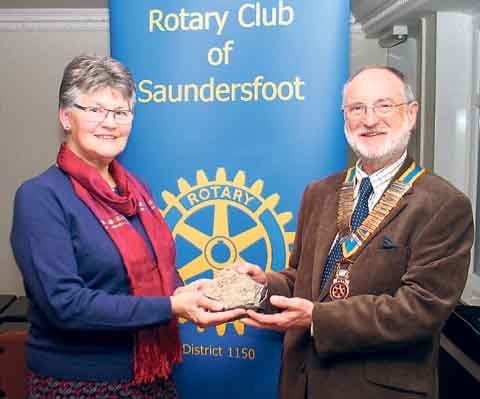
On Monday, January 19, Elizabeth Talboys (the wife of Saundersfoot Rotary Club's immediate past president, Rob Talboys) gave a fascinating insight into the geology of Saundersfoot.
Elizabeth's interest in geology started when she was eight years of age when she dug holes in her parents' garden and discovered layers of clay beneath the fertile top soil. This interest was further stimulated in the 1960s by the theory of Plate Tectonics and ultimately Elizabeth secured an Honours Degree in Geology.
Elizabeth explained the three classifications of rocks based upon the way in which they were formed. Sedimentary rocks are rocks formed from sediment deposits beneath bodies of water such as rivers, lakes or seas. Igneous rocks (as the name implies) are linked to volcanic activity and the solidification of magma, ash or lava. Whereas metamorphic rocks are rocks that have been changed by heat or pressure.
Elizabeth brought her talk to life by passing around samples of the three classifications of rocks and describing their formation and structure. She also produced several publications by the British Geological Survey showing the solid geological deposits in Wales and Pembrokeshire; and it became clear from the maps that most of Saundersfoot was underlain by sedimentary rocks from the Carboniferous System which were formed 360 - 286 million years ago.


The maps also showed the presence of geological faulting and the Carreg Cennon Fault which extends from Saundersfoot towards Church Stretton. The faults represent lines of weakness in the earth's structure and movement can occur in their proximity from time to time; the most publicised fault movement being associated with the San Andreas Fault, and the earthquake which affected San Francisco. Small movements do occasionally occur on fault lines in the UK and British Geological Survey publishes information on such events.
Elizabeth has spent hours researching the geology in Pembrokeshire which possibly displays a greater variety of geological features than any other equivalent area of the same size in the UK, which probably explains the ongoing interests of the casual visitor and geology students.
To illustrate this, Elizabeth showed a series of slides taken at various locations in Saundersfoot Bay and explained their content; the final slide being of the Ladies Cave in Saundersfoot which is an excellent demonstration of the extreme pressures that the original rock formation was subjected to to produce the anticlinal structure we see today and which is of international importance.
The whole presentation was fascinating and evoked many questions from the members. Finally, a well-deserved vote of thanks was given on behalf of the members by past president Keith Leighfield.
Comments
This article has no comments yet. Be the first to leave a comment.