
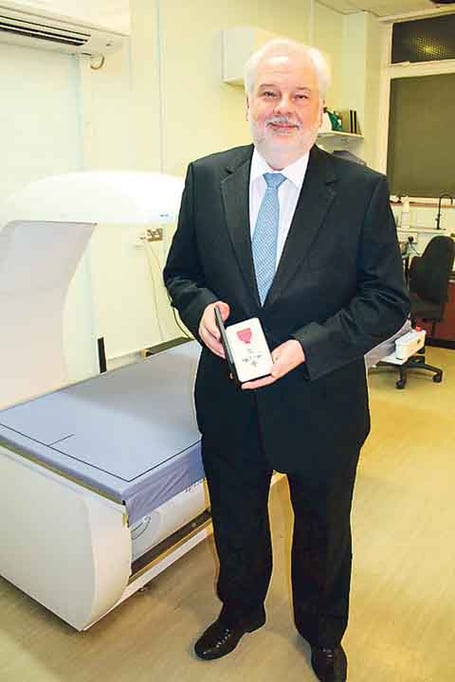
LOCAL readers may be interested to know that a Cardiff and Vale University Health Board consultant clinical scientist has been awarded an MBE for his services to the NHS in Wales and overseas.
Professor Evans has worked for Cardiff and Vale UHB for the past 38 years, joining as a basic grade medical physicist after graduating in physics from Jesus College, Oxford, in 1972, and obtaining a PhD from the University of Wales.
In the early part of his career, Professor Evans was closely involved in setting up Nuclear Medicine services at the East Glamorgan Hospital in Church Village and at other district general hospitals throughout South East Wales. These services continue to be supported by his staff based at the University Hospital of Wales.



Professor Evans pioneered the development of local facilities for the measurement of bone density in relation to the diagnosis and monitoring of osteoporosis.
In the early 1980s, Professor Evans, along with his team, built a device to measure bone density in the forearm and devised a method to measure bone density in the spine using a whole body x-ray computed tomography (CT) scanner. On the back of these developments, he was able to raise money to purchase the first DEXA scanner in Cardiff in 1991. The team currently undertake about 7,000 DEXA scans per year at the University Hospital of Wales.
Professor Evans said: "Throughout my life I've always had a passion for physics. I felt very proud to receive the MBE in recognition of work that I love doing. It was a complete surprise to me and I'd like to thank everyone that I've worked with during my career. I look forward to plenty of new challenges in the future."
Adam Cairns, the health board's chief executive, said: "I am delighted Professor Evans's devotion to his speciality, to teaching and patient care has been recognised in such a prestigious way. I know his many friends and colleagues will be extremely pleased to hear about his much-deserved MBE."
Professor Evans trains and mentors medical physicists and clinical technologists and has spent time teaching in other countries for the Fellowship of the Royal College of Radiologists, sharing his knowledge and expertise all around the world. His opinion is valued by his clinical colleagues and he sits on national committees that make recommendations to Government on scientific services in the NHS and issues such as the safe use of radiation.
Comments
This article has no comments yet. Be the first to leave a comment.