

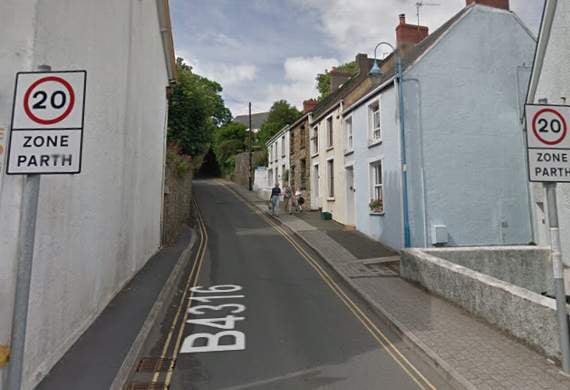
Plans for the alteration of existing boundary walls and the creation of a new dwelling on a busy one-way road in Saundersfoot have been deferred for a site meeting.
The application submitted by Mr. D. Slade, for a site at Velfrey Cottage, located within the centre of the village along Church Terrace between High Street and Frances Lane, came before members of the Pembrokeshire Coast National Park Authority’s development management committee at a meeting last week.
The site is currently part of Velfrey Cottage’s garden area and has an elevated position above Church Terrace, with the remains of a static caravan and overgrown vegetation covering most of the site.
Approval is being sought for the sub-division of the garden of Velfrey Cottage to form a plot for a new two-storey three-bedroomed residential dwelling. The proposed works will alter the existing stone frontage boundary wall to create a new access and delivery bay. Above the wall, a lean-to en-suite and external log store will be provided which will also extend the stone wall vertically.



The application was reported to the committee because the views of Saundersfoot Community Council were contrary to the recommendation of planning officers, who had recommended approval with conditions
The community council had objected to the application as they considered the current proposal failed to harmonise with the landform and landscape character of the National Park.
Letters of objection had been received from neighbouring properties raising concerns such as - traffic and pedestrian safety and disruption to traffic and emergency services; use of pavement by school children; the design was not in-keeping with surrounding buildings, with an excessive two-storey scale on an elevated position, overlooking and impacting on privacy to neighbours.
Objectors also pointed to the location of the proposal to immediate adjacent buildings and the possibility of structural damage being caused to chapel foundations from construction work.
Addressing the meeting, objector Mrs. Pamela Mortimer said that road safety was her main concern.
“Any parking on the double yellow lines along that one-way road system causes a traffic jam and brings the whole of Saundersfoot to a stop!
“It is a busy route for buses with the school nearby, and the safety of children walking to school and from could be at risk.
“It is dangerous, and many older residents in the village also use this route, so it would be an accident waiting to happen if this development was approved,” she continued, asking for a site meeting to be called, preferably when the school buses were dropping-off or picking-up to see the effect that the road had on the community when traffic came to a standstill.
The applicant’s agent, Mr. Steve Hole, told the meeting that the road was considered wide enough for a single carriageway and a temporary footpath should construction work be granted.
“Pembrokeshire County Council’s highways department consider the development to be quite safe enough, and we have taken great care to ensure this,” he remarked.
Committee member, Clr. Phil Baker, who is also county councillor for Saundersfoot and PCC’s cabinet member for planning and infrastructure, stated that his two main concerns were the volume of the building and the existing retaining wall.
He also voiced his concerns regarding construction lorries using the one-way system.
“Any deliveries to the site would struggle to use the road if part of the footpath is closed off, as I recently followed a lorry taking a static caravan up that road, and it had to drive with two wheels on the footpath to get through,” he said.
“With school children also wanting to use the road, this could be very, very difficult. It could be too large a project to physically construct a building of that volume in that location,” continued Clr. Baker, recommending that a site visit be made during school time.
Find out about planning applications that affect you by visiting the Public Notice Portal.
When put to the vote, the majority of members agreed to a site visit for the proposed development.
Comments
This article has no comments yet. Be the first to leave a comment.