
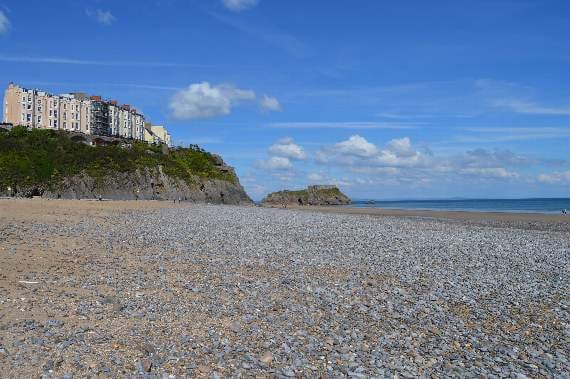
Sir, The Golden Sands of Tenby were the obvious choice for Sunday School trips, when I was a child in the 1950s. How disappointed my friends and I would be if we were brought to South Beach, Tenby, today. With the exception that it is washed twice a day, the gravel pit, that is now South Beach, is not much better than the coal tips that were our childhood playgrounds in the 1950/60s.
I have read with interest recent letters regarding the vanishing sand. However, your front page headline ‘Dredging Debate’ prompts me to contribute to this problem. I use the word ‘Problem’ advisedly. It is a problem and not, in modern parlance, an ‘Issue’. Problems need to be dealt with. Issues, on the other hand, tend to get lost in the bureaucratic jungle of committees and buck passing.
So, let us look at some of the comments in your headline article.
• PCC stated that they ‘have an obligation not to interfere with natural processes’. Dredging, which has been carried out, interferes with natural processes. This, in itself, is a contradiction.




• It is now Summer and peak visitor season. I think PCC’s coastal engineer, Emyr Williams, is being a little optimistic when he states that sand would return by Summer. The sand is needed now. Summer is here!
• His further comment - ‘may benefit from suggestions to put the sand back on South Beach rather than offshore from dredging’ seem to make sense.
• If depositing the sand where, in the short term, it covers some of the gravel pit, that is now South Beach, I suggest that PCC and NRW sort out their differences and look at short term measures such as this. Just try it!
Visitors, Tenby’s lifeblood, deserve it. There must be a contingency fund hidden somewhere.
• Mr. Williams’s remarks regarding the effect of culverting of the Ritec in the 1850s confuse me. The culverting did not seem to have much of a detrimental effect on the Golden Sands in the hundred years up to the 1950s; or even during the next 50 years or so into the early 21stC.
• From my observations, the situation seems to have deteriorated extremely rapidly. I have walked the shoreline from South Beach to Giltar regularly since I came to live in Pembrokeshire six years ago.
• The sand bank seems to remain fairly stable, despite Dr Tony Thomas’s claim that the topography had changed due to ‘climatic conditions’.
• Perhaps he, and some of our many experts, could explain to us why it is not possible to reduce the removal of sand between the dunes and the sandbank by the reinstatement of newly designed groynes between Giltar and the sandbank.
C. J. Roberts,
Pembroke
Comments
This article has no comments yet. Be the first to leave a comment.