

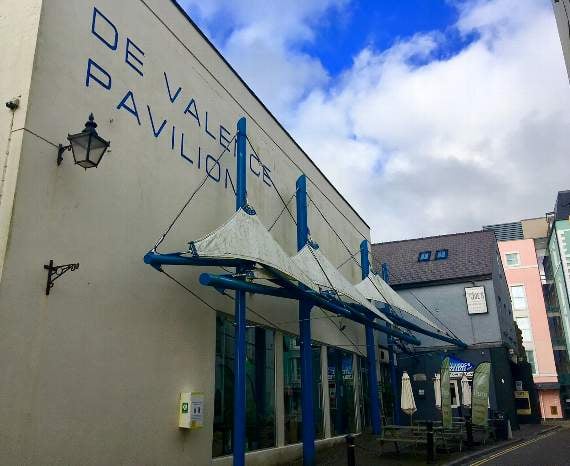
Last Tuesday’s well-attended film was shown in the main downstairs area of the De Valence (as opposed to the previous screening which was up in the gallery area). Was this, perhaps, because the great Oscar-winning Geoffrey Rush headed the bill? (writes June Howell). In ‘Final Portrait,’ Rush plays famous artist and sculptor, Alberto Giacometti; plays him towards the end of his life, and particularly, during a period when he undertook to paint the US acclaimed writer and critic, James Lord. (Armie Hamer). You probably couldn’t get two more diametrically opposed characters than the world-weary bohemian, Giacometti, and the worldy, urbane Lord. Something of ‘Rage, rage at the dying of the light,’ springs to mind, as the alternately manic and depressive artist faces his imminent mortality. The never-ending search for perfection, and starting over, is all concentrated into the composition of his portrait of James Lord, which Lord soon discovers is a never-ending exercise in ‘finish, destroy and start again,’ just like the last couple of world wars. Director and writer Stanley Tuca introduces a good helping of humour into the piece, courtesy of Armie Hamer’s brilliant portrayal (excuse the pun) of James Lord. From the moment he uncomfortably lowers himself into the grimy chair, in the grimy studio, you know he is going to be the butt of all Tuca’s (and Giacometti’s) jokes. There aren’t actually many jokes per se, but we revel in Lords discomfiture, and his total misunderstanding of everything going on around him, despite him priding himself on his great breadth of understanding of art.



If you like existentialism, and all that smoke-wreathed post-war Paris, and the demi-monde, then ‘Final Portrait’ is the film for you. Ninety per cent of the action takes place in Geacometti’s studio, which another well-known writer at the time described as ‘a seething dump.’ At any rate, the set-designers (location consultants, or what ever) achieved the right look - seedy and grimy - and only alternated it occasionally with another seething dump of a bar, or could it be more accurately described as a ‘pick-up joint?’ Either way, both venues were decidedly depressing; occasionally we were treated to a brief glimpse of Parisienne streets, but as the action took place is 1964, they were pretty seedy too. That’s your lot for ‘on location’ - not a lot, but historically accurate down to the last gitane stub.
Supporting roles by Sylvie Testud and Clemence Poesy, playing respectively Giacometti’s partner and Iover, were superbly well-accomplished, but this is a film I wouldn’t see a second time. Geoffrey Rush was, as ever, a tour de Force, awash with gallic shrugs and gestures, but, suffice it to say, he and it, didn’t get any awards this time. Am I surprised?
Next film on Tuesday, June 5, is ‘The Greatest Showman,’ a musical drama based on the true life story of Barnum, the American circus director. Screening at 7.30 pm, with pre-film supper available at Fuchsia Cafe, next door, or enjoy a drink in the De Valence bar.
Comments
This article has no comments yet. Be the first to leave a comment.