
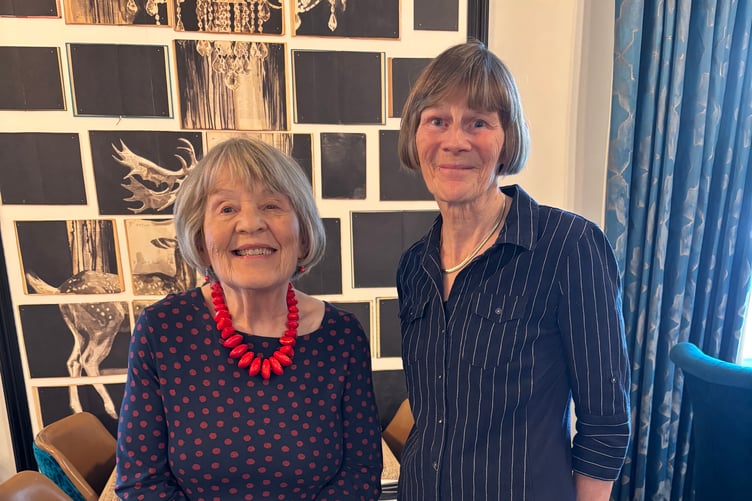
FOR the May meeting of Narberth Ladies Probus, acting president Sonia was pleased to welcome Vicky Tomlinson to the Plas Hyfryd Hotel to talk about the seven ages of Ynys Bŷr (Caldey Island).
Vicky began with Caldey’s prehistory. Its earliest rocks were formed over 400 million years ago, she said, and it wasn’t cut off from the mainland until about 5,000 years ago. Archaeologists have discovered bones and human remains thought to date back as far as 20,000 years ago.
Vicky then moved forward many thousands of years to the period spanning 500 – 900 AD and Caldey’s connection with Celtic saints, such as St Sampson and St Dubricus and its monastic past. Indeed, the Welsh name for the island, Ynys Byr, refers to the first Celtic abbot, St Pyr.
Next, Vicky discussed the period from 1100 to 1500, during which time the island was gifted to St Dogmaels Abbey, a Benedictine order, and the old priory was built which is still visible today.



After the dissolution of the monasteries in the 16th century, there followed a secular phase. The island had a variety of owners and was farmed by tenant farmers. In 1798 it was sold to Thomas Kynaston and it remained with his family until 1867. So began the fifth age of the island’s history, and Caldey’s industrial and agricultural phase with the commercial quarrying of limestone and more intensive farming.
In 1897 the island was sold to the Rev’d Done Bushell to provide a holiday retreat for his large family. Caldey’s sixth and possibly most fascinating chapter began with the arrival of Aelred Carlyle, the future abbot, who visited the island in 1900 with some of his fellow brothers to help Rev’d Bushell with the farm work.
Aelred Carlyle fell in love with the island and, in 1906, bought it from Rev’d Bushell. He set up a Benedictine Anglican abbey. The charismatic, yet sometimes profligate, Carlyle persuaded a variety of high church enthusiasts to either donate or loan funds for the ambitious building projects he started on the island, including the current monastery, workmen’s cottages and a guest house.
At one point, over 100 people from the Tenby area were employed in these enterprises. In 1913 Abbott Aelred and 26 members of the community announced their intention to convert to the Roman Catholic church. However, they were in financial difficulties. Abbott Aelred departed for Canada in 1921 and in 1925 the Catholic Church arranged for the Order of Reformed Cistercians to purchase it. In 1928 the remaining members of the Benedictine community left Caldey for Prinknash Abbey in Gloucestershire.
Caldey was adopted as a daughter house of a Cistercian Abbey in Belgium which sent a small group of Belgian Cistercians to the island and their order remains there today. This leads to the seventh age in Caldey’s long history. The people of Tenby may have been a bit mystified by the arrival of the foreign Cistercian community on the island. However, with the arrival of English speaking Brother Thomas in 1932, barriers were broken down and friendships slowly formed.
Brother Thomas initiated the ferry service of boats which take day tourists to and from the island through the holiday season. There are many wildlife delights to enjoy along with the rich history. Tourism has replaced farming and most animals on the island are kept for grazing management.
Vicky concluded her talk by sharing many interesting photographs of Caldey’s past and a rich variety of source material by writers such as Roscoe Howells, John Woodcock and Christopher Howells. Jan thanked Vicky for her most informative and interesting talk.
The next Probus meeting will be on Friday June 5 at the Plas – new members are always welcome.
Comments
This article has no comments yet. Be the first to leave a comment.