

Since the dawn of the Young Farmers Clubs movement, thousands of its members have donned their hiking boots, unearthed their sense of adventure and slapped on the sun cream heading off for the discovery of a lifetime in the form of an international exchange.
Part of a worldwide association of farm youth bodies, the YFC have consistently been arranging a totally incomparable homestay programme offering trips to many countries around the globe, staying with host families and learning at first-hand all about new ways of life in their host country and experiencing aspects of daily life that tourists rarely see.
Living and working with farming families in a range of other countries affords an opportunity of studying their home lifestyles, farming cycles, livestock, cropping and mechanisation, aims and development prospects for the years to come.
Some trips now last from two weeks to considerably longer staying in the home of a member of a rural youth agency in the country of their choice. It has proven time and again to be a great way to make new friends and experience rural life in a different country and, as always, the more you put into it the more you got out.



The YFC has always fully recognised that members are all unique and want different things from their adventures but the question is sometimes asked: “Why would anyone want to stay in somebody else’s home?”
The answer is that it not only affords a fantastic way to experience another country but you will be very well looked after whilst you are there - you have the chance to experience another way of life by living it. See new places, make new friends and soak in another culture - it’s an adventure that will pay off for the rest of your life.
One person who most certainly agrees is Richard Morgan who was an active member of Whitland club more than 50 years ago. He was successful - with five others from England, Scotland and Northern Ireland - in obtaining an eight month farm youth exchange visit to Australia funded by the Pacific and Orient (P&O) line.
His fellow exchangees were: from England - Pam Liddiart, Berkshire, Gordon Jones, Hampshire, William Hamilton, Suffolk, together with John Duncan from Ayrshire, Scotland, and Elizabeth Tweed from Co. Antrim, Northern Ireland.
The opportunity to fly out there was not an option in 1966 so they sailed on the SS Iberia from Tilbury on an outward journey that took a month during which time they were guests of the ship’s captain.
En-route, the liner crossed through the Mediterranean, calling in at Port Said before passing through the Suez Canal. She continued into the Red Sea and, after calling in at Aden, she traversed the Indian Ocean calling in at Mumbai (known as Bombay then), Colombo, Fremantle, Western Australia, Adelaide, South Australia, and Melbourne, Victoria, before arriving at Sydney in New South Wales 33 days later.
The young farmers had to dress up each evening for dinner at the captain’s table and were expected also to help provide the onboard entertainment for the 1,400 other travelers on the outward and return journeys.
On reaching Australia, two members, one of whom was Richard, disembarked at Freemantle, two more at Melbourne and the last at Sydney.
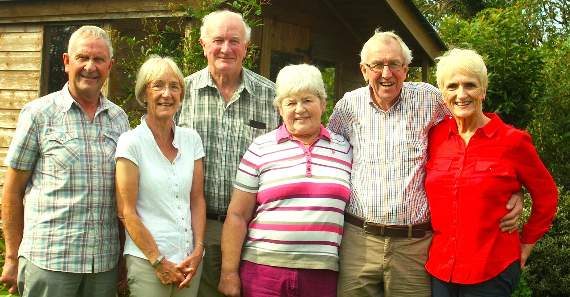
All this occurred half a century ago and Richard recently brought four of the ‘golden oldies’ together for a three-day reunion in Pembrokeshire, although some had actually kept in touch and met up from time to time over the intervening period. Unfortunately, John, well into large scale dairy farming and who is a past chief executive of First Milk, could not get away and William - an extensive arable farmer and a prominent NFU committee member - had sadly passed away a year ago.
Richard has retired from dairy farming during which time he had taken a very keen interest in making the most of his grassland. He was one of the early members of the Narberth Grassland Society and, as a delegate, was later elected chairman of the Wales Federation.
Based in Winchester, Gordon - who met his future wife, Elizabeth, on this visit to Tazmania - had worked in farm management and become county chairman of his YFC Federation. The opportunity arose in the ’70s to buy her parents 300-acre farm in Tazmania where they were to run a herd of 120 Friesian milking cows and also growing cereals and poppies (on contract to Glaxo to produce morphine).
Pam, who also had a strong farming background, was a highly-proficient public speaker and was connected with the media before setting up a pest control business and Elizabeth progressed to become a part-time lecturer at the College of Agriculture, Food and Rural Enterprise, Greenmount, which provides education and extensive training for the food and land-based sectors.
On the exchange, Richard’s first experience was working within the wheat belt of western Australia moving on to the southern territory which was more into dairy stock, apple growing and wine production.
They were certainly not given an easy time because, as good YFC ambassadors, they were expected to take up the challenge of the locals in stockjudging competitions at the major shows and they were frequently in invited to address gatherings across a broad spectrum - not just young farmers.
All were agreed that reliving those past experiences, and looking back whimsically over the intervening years and the many changes which have come about in the rural scene, made the whole reunion weekend so very worthwhile for all concerned.
Comments
This article has no comments yet. Be the first to leave a comment.